Ashutosh Mishra

Research

Modular reconfigurable lunar robots

If you can only land a fixed mass on the Moon, should it be one specialised machine or a set of parts?

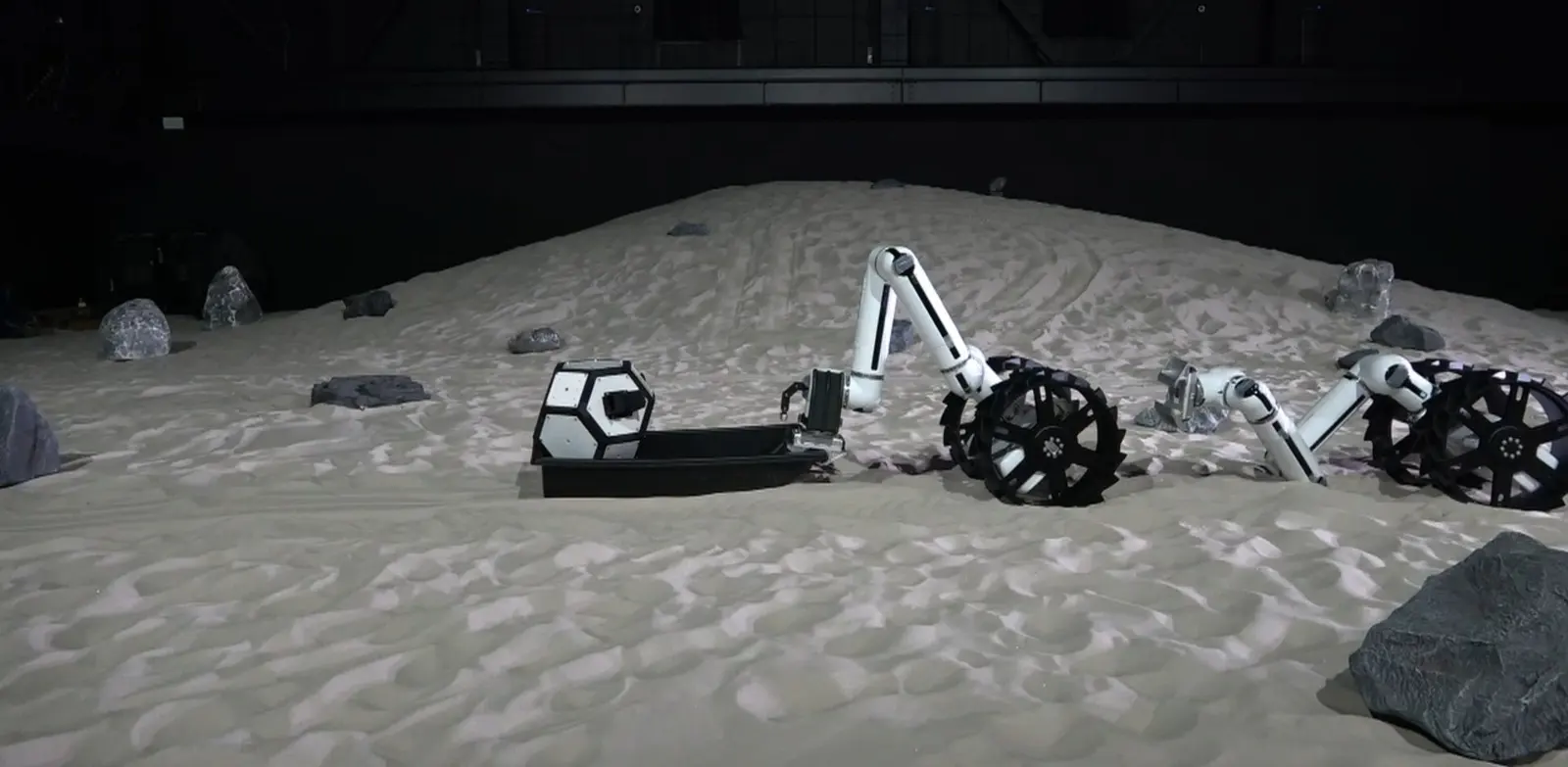
Two MoonBot configurations working as a team, a Minimal and a Dragon, clearing rocks to prepare the ground for infrastructure, JAXA Space Exploration Test Field.

Every kilogram delivered to the lunar surface is expensive enough that sending three single-purpose machines is hard to justify when one set of reconfigurable parts could do all three jobs. That is the argument behind MoonBot, developed at the Space Robotics Lab at Tohoku University under JST Moonshot Goal 3: limbs, wheels and tools that attach on demand, so the same hardware becomes a manipulator, a vehicle, a walker or an excavator depending on what the task requires.

Modularity moves the difficulty rather than removing it. A robot whose morphology changes cannot rely on a controller written for one fixed body, and it cannot rely on a central planner that assumes it knows what is attached. Most of my doctoral work went into that problem: decentralized control and reinforcement learning for a body that keeps changing, and the software that lets the modules work as one machine.
MoonBot in depth, with video

Field tested at

  • JAXA Space Exploration Test Field, Sagamihara
  • Abukuma Cave, as a stand-in for lunar cave environments

Projects in this direction

3

Publications in this direction

5
IEEE T-FR2025

MoonBot: Modular and On-Demand Reconfigurable Robot Toward Moon Base Construction

Kentaro Uno*, Elian Neppel*, Gustavo H. Diaz*, Ashutosh Mishra*, Shamistan Karimov*, A. Sejal Jain, Ayesha Habib, Pascal Pama, Hazal Gozbasi, Shreya Santra, Kazuya Yoshida

IEEE Transactions on Field Robotics (T-FR)

The MoonBot platform: limbs, wheels and tools that recombine on demand into whichever machine a lunar construction task needs, developed under JST Moonshot Goal 3 and shown in a preliminary field demonstration of lunar infrastructure tasks.

* Equal authorship.

IEEE iSpaRo2025

Multi-Modal Decentralized Reinforcement Learning for Modular Reconfigurable Lunar Robots

Ashutosh Mishra, Shreya Santra, Elian Neppel, Edoardo M. Rossi Lombardi, Shamistan Karimov, Kentaro Uno, Kazuya Yoshida

IEEE International Conference on Space Robotics (iSpaRo)

A decentralized reinforcement learning approach for robots whose morphology changes: each module learns to act on local, multi-modal observation rather than from a central controller, so the same policy set survives reconfiguration.

Best Paper Award in Planetary Robotics, IEEE iSpaRo 2025, Sendai, Japan

IEEE iSpaRo2025

Designing for Distributed Heterogeneous Modularity: On Software Architecture and Deployment of the MoonBots

Elian Neppel, Shamistan Karimov, Ashutosh Mishra, Gustavo H. Diaz, Hazal Gozbasi, Shreya Santra, Kentaro Uno, Kazuya Yoshida

IEEE International Conference on Space Robotics (iSpaRo)

The software architecture question behind modular hardware: how to deploy and coordinate software across heterogeneous modules that do not know in advance what they will be attached to.

IEEE/RSJ IROS2025

Robust and Modular Multi-Limb Synchronization in Motion Stack for Space Robots with Trajectory Clamping via Hypersphere

Elian Neppel, Ashutosh Mishra, Shamistan Karimov, Kentaro Uno, Shreya Santra, Kazuya Yoshida

IEEE/RSJ International Conference on Intelligent Robots and Systems (IROS)

Keeping multiple limbs of a space robot synchronized when any of them may be added, removed or delayed, using hypersphere trajectory clamping to bound the motion each limb is allowed to command.